
The Great Debate: Open-Concept vs. Traditional Layouts for Your Spokane Home
Picture a typical Tuesday evening in November here in the Inland Northwest. It’s 5:00 PM, pitch black outside, and the temperature is dropping. Your family is gathered inside for the night. You’re starting dinner, the kids are tackling homework, and the TV is humming in the background.
In this moment, the architecture of your home dictates your experience.
Are you part of a lively, communal hum where you can chat with the kids while chopping vegetables? Or are you craving a quiet sanctuary where sound doesn’t travel, allowing for focused study and a peaceful kitchen?
For many first-time homebuyers and relocating families looking at Architerra Homes, the choice between an open-concept and a traditional layout often feels like a purely aesthetic decision. But as we explore the design philosophy behind the Debut Collection, you’ll discover that this choice is actually about the psychology of how your family functions.
Let’s strip away the industry jargon and look at how these floor plans shape daily life in Spokane.
Defining the Contenders
Before we weigh the pros and cons, it is helpful to establish exactly what we are comparing. The real estate industry often throws these terms around loosely, so let’s clarify the definitions.
The Open-Concept Philosophy
An open-concept floor plan removes the barriers (walls and doors) between the main living areas—typically the kitchen, dining room, and living room.
- The Goal: To maximize natural light and foster social connection.
- The Vibe: Airy, spacious, and communal.
- The “Aha” Moment: It makes smaller square footage feel significantly larger because your eye travels further before hitting a wall.
The Traditional Layout Philosophy
Traditional floor plans rely on defined rooms separated by walls and hallways. Each space has a distinct purpose and a clear boundary.
- The Goal: To provide privacy, noise control, and functional separation.
- The Vibe: Cozy, structured, and organized.
- The “Aha” Moment: Walls aren’t just barriers; they are sound buffers and “mess blockers.”
The “Spokane Factor”: Why Geography Matters
Most home design articles you read online are generic. They don’t account for the unique lifestyle of the Pacific Northwest. When evaluating the Debut Collection for a life in Spokane or Post Falls, you have to factor in our specific environment.
1. The Light Dilemma
In the Inland Northwest, we cherish our summers, but we must respect our winters. From November to March, natural light is a premium resource.
- Open-Concept Edge: By removing walls, light from windows on the south side of the house can penetrate through to the north side. This is vital during our gray winters to keep the home feeling bright and cheerful.
- Traditional Challenge: Without strategic design, interior rooms in a traditional layout can feel darker during the winter months, requiring more artificial lighting.
2. Heating and Energy Efficiency
Spokane has four distinct seasons. We have hot Augusts and freezing Januaries.
- Open-Concept Reality: Large, open spaces can be harder to heat and cool evenly. However, modern construction standards used by builders like Architerra—including high-efficiency windows and insulation—mitigate this significantly compared to older homes.
- Traditional Reality: It is often easier to zone-heat a traditional home. If you spend all evening in the living room, the heat stays in that room rather than dispersing into the kitchen and dining area.
3. The Mudroom Necessity
In many warmer climates, the transition from outside to inside is casual. In Spokane, between snow, mud, and rain, the “transition zone” is critical.
- Design Insight: Regardless of whether you choose open or traditional, look for plans in the Debut Collection that feature a dedicated entry or mudroom space. This prevents the “outdoor mess” from immediately becoming part of your open living area.
The Daily Life Test: Privacy vs. Connection
When you tour a model home, it is usually quiet and pristine. But you need to imagine the home on a chaotic Saturday morning. Here is how the layouts perform under pressure.
The Noise Factor
Open Concept: Sound travels. The blender in the kitchen, the football game on TV, and the video game in the corner all compete. For families who love high energy and togetherness, this is a feature. For those sensitive to noise, it can be a bug.
Traditional: Walls are excellent sound absorbers. If you work from home or have a multi-generational household, traditional layouts (or hybrid variations) offer necessary acoustic retreats.
The “Visual Noise” Factor
This is a concept many buyers overlook. “Visual noise” is clutter.
Open Concept: If your kitchen is messy, your living room feels messy. There is no hiding the dinner dishes while you relax on the couch.
Traditional: You can leave the pots in the sink, walk into the living room, and relax in a visually tidy space. The wall hides the chore until you are ready to deal with it.
The Supervision Factor
For families with young children, this is often the deciding factor.
Open Concept: You can cook dinner while watching the toddler play in the living room. The “sightlines” are clear, offering peace of mind.
Traditional: Requires more active monitoring as you cannot see around corners.
Inside the Architerra Debut Collection Approach
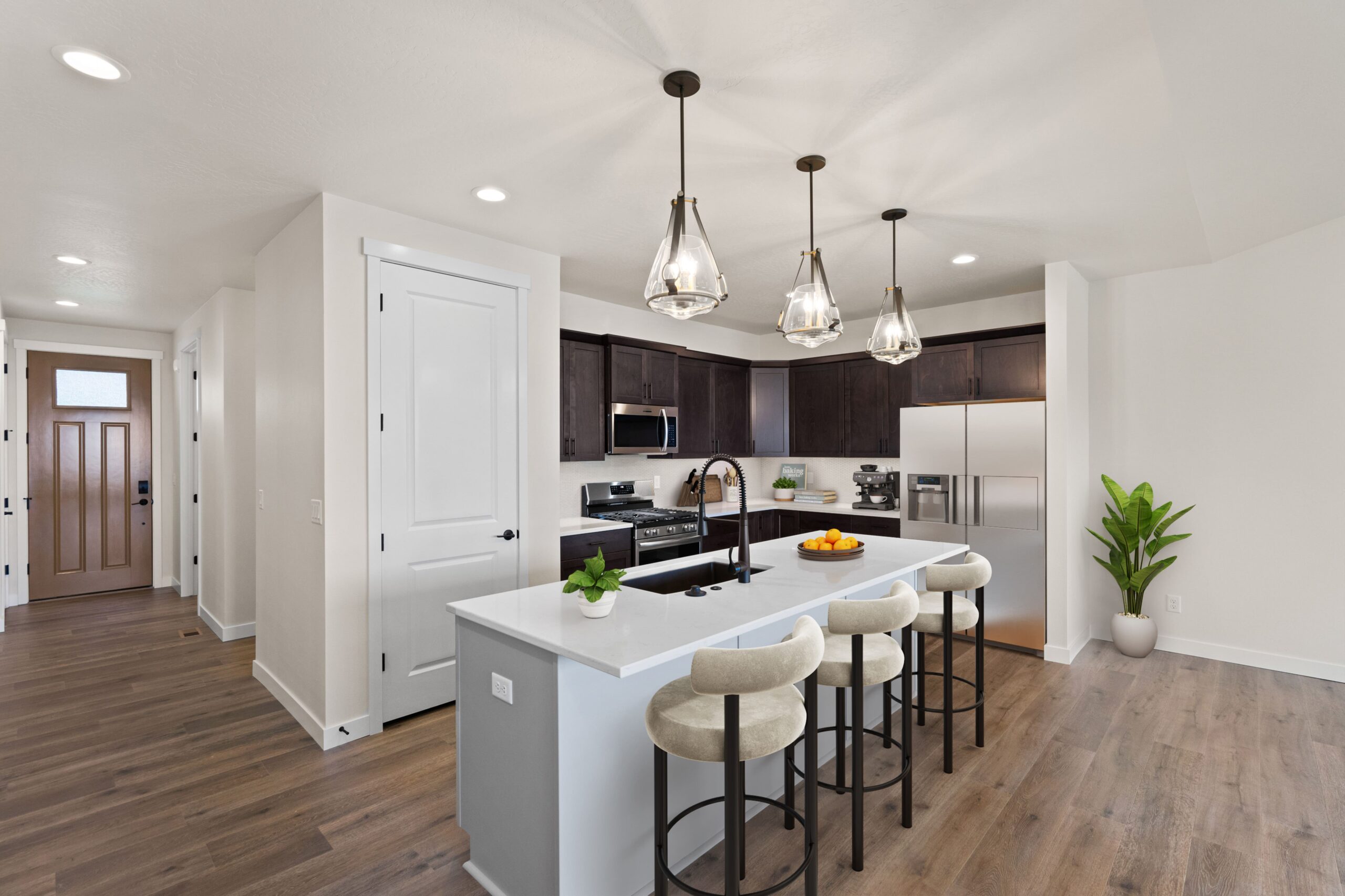
Here is where the Architerra Debut Collection shines. Rather than forcing you into a rigid “box” of 1950s isolation or a warehouse-style void, modern floor plans often utilize a Hybrid Approach.
Architerra designs often feature:
- Open “Great Rooms”: Merging the kitchen and family room for that essential daily togetherness.
- Defined Retreats: Keeping bedrooms and flex rooms (like dens or offices) distinctly separate to provide privacy where it counts.
- Strategic Sightlines: Designing angles so you get the light and flow, but perhaps the view of the kitchen sink is tucked away from the main entry.
This “best of both worlds” approach is why the Debut Collection resonates so well with modern buyers. It acknowledges that we want to be together, but we also need a place to take a Zoom call.
FAQ: Common Questions from New Homebuyers
Is an open-concept home more expensive to build?
Generally, open-concept homes require larger structural beams to support the roof without interior load-bearing walls. However, because the Debut Collection is master-planned, these engineering costs are optimized, keeping the price point accessible for families.
Which layout is better for resale value in Spokane?
Currently, the market leans toward open-concept or hybrid layouts. Modern buyers prefer the sense of spaciousness and light. However, as remote work remains permanent for many, having at least one dedicated, enclosed room (like a den or office) has become a massive selling point.
Can I paint an open-concept room different colors?
This is a common design challenge! In open layouts, walls share corners, making it hard to stop one paint color and start another. We usually recommend a cohesive neutral palette for the main areas, using texture, furniture, and art to define different “zones” like the dining area or lounge space.
Finding Your Flow
There is no “wrong” choice—only the choice that fits your family’s rhythm.
If you thrive on connection, love natural light, and don’t mind a little background hum, the open-concept designs in the Debut Collection will likely feel like a breath of fresh air.
If you value acoustic privacy, prefer cozy spaces, and want to compartmentalize the “mess” of daily life, look for plans that offer more traditional separation or distinct zoning.
The best way to decide? Don’t just look at the 2D floor plan. Walk the space. Stand in the kitchen and imagine it’s 5:00 PM in November. Listen to the acoustics.
Your home is the backdrop for your life’s memories. Choosing the right stage makes all the difference.
Defining the Layout Options
When comparing home layouts, it is helpful to move beyond common labels and consider the underlying design intent. Floor plans are typically organized around how space is divided, connected, and used on a daily basis.
Two primary approaches dominate residential design: open-concept layouts and defined (traditional) layouts.
Open-Concept Layouts
Open-concept floor plans became more common in the late 20th century as residential design shifted away from highly compartmentalized interiors. These layouts reduce or eliminate walls between primary living spaces such as the kitchen, dining area, and living room.
Characteristics
Fewer interior walls separating shared living spaces
Expanded sightlines across multiple rooms
Increased natural light penetration when windows are shared across spaces
Design Considerations
Activities in one area are visually and acoustically connected to adjacent spaces
Odors, sound, and visual clutter are not contained within a single room
Defined (Traditional) Layouts
Defined layouts organize the home into rooms with distinct functions. Walls and doorways are used to separate spaces such as kitchens, living rooms, dining rooms, and offices.
Characteristics
Clear functional separation between rooms
Increased ability to manage sound and visual privacy
Greater flexibility to use rooms independently
Design Considerations
Movement between rooms is more deliberate
Gathering multiple activities into one space may require planning
Evaluating Layouts for Daily Use
When reviewing floor plans, it can be useful to picture everyday routines rather than staged photography.
Visual Organization
In open layouts, kitchen and living spaces are continuously visible to one another. Items such as dishes, paperwork, or small appliances remain in view unless stored. In more defined layouts, visual separation allows one space to remain out of sight while another is in use.
Remote Work and Study
As home offices and remote work have become more common, layout choice can influence how space functions during the day.
Open layouts provide flexibility but limited sound separation
Defined rooms offer enclosed spaces suitable for focused work, meetings, or study
Walls and doors remain the most effective method of controlling sound within a home.
Entertaining and Hosting
Different layouts support different hosting styles.
Open layouts allow hosts to remain visually connected to guests while preparing meals
Defined layouts separate preparation areas from dining or gathering spaces
Both approaches are commonly used, depending on preference.
Ready to feel the difference for yourself? Explore the floor plans available in The Debut Collection and visit one of our communities to experience how thoughtful design comes to life.
